
‘Dolly’ Movie Review: Say Hello To New Slasher Icon In Otherwise Tiresome Homage
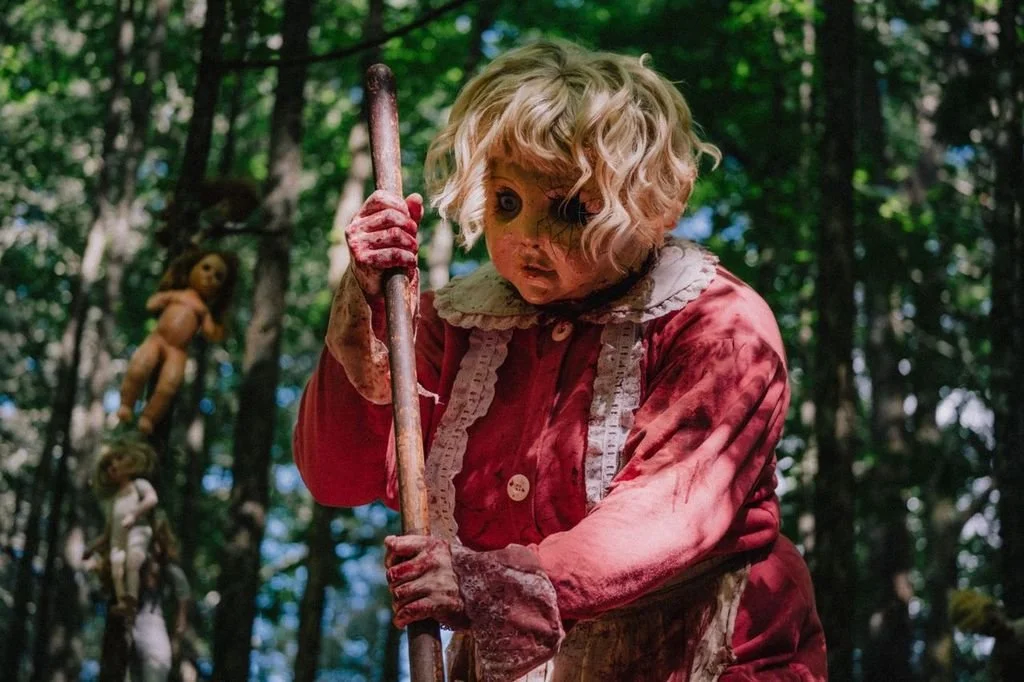
Photo from Independent Film Company
From Jeremy Kibler
The Texas Chain Saw Massacre has long been a big influence on a lot of horror films, and that influence is proudly worn on the blood-spattered, breast-milk-stained sleeve of writer-director Rod Blackhurst’s Dolly. Blackhurst conjures up an unsettling tone, particularly with whom he cast to play the titular Dolly, but the film remains a pretty standard genre exercise hellbent on creating a throwback look and feel to grimy, relentless, shockingly violent backwoods horror. Unlike Tobe Hooper’s seemingly brutal but masterfully suggestive 1974 classic, Dolly is more keen on delivering unpleasantness and rubbing our noses in it. At only 82 minutes, the nastiness gets tiresome and repetitive after a while.
Co-written by Blackhurst & Brandon Weavil, the film is told in seven chapters, rather needlessly so, for what is a simple setup to a cat-and-mouse narrative. Single father Chase (Seann William Scott) takes girlfriend Macy (Fabianne Therese) on a hiking trail so he can propose at a scenic overlook. Let’s just say they get interrupted when coming across a music box playing a bunch of dolls nailed to trees in the woods. When they should have gotten the hell out of Dodge, that isn’t what happens. Instead, Macy is abducted and taken to the rotting home of “Dolly,” a hulking, bow-legged woman (Max the Impaler, making their acting debut) who hides behind a cracked porcelain-doll mask and wields a sharp shovel. Eventually, Macy learns she’ll have to play along to survive, even if that means letting Dolly treat Macy like a baby (yes, diaper changes and feedings are essential).
An expansion of Blackhurst’s 2022 short Babygirl, Dolly is proof of concept that Dolly, herself, could be a potentially iconic slasher villain. Nonbinary professional wrestler Max the Impaler cuts a wheezing, freakishly childlike but physically strong and intimidating monster, who’s prone to rocking and temper tantrums when they aren’t lopping off jaws and heads with their ground-digging tool. Top to bottom, Dolly is a memorable horror creation to almost rival Leatherface. Just don’t expect much backstory for Dolly herself in Blackhurst and Weavil’s uninteresting script, although Macy does get to use a little Mommy Voorhees psychology that has made the maniac infantile and deranged (also not unlike The Mother in Zach Cregger’s Barbarian).
Both Sean William Scott and Fabianne Therese are game to endure a lot with this extreme material (and the effective foley work of bones breaking and flesh ripping makes you feel it). Their plight can be harrowing and disturbing, however, there is a lot of strained character logic to get the plot moving where it needs to go that Chase, especially, may as well be acting in a horror-movie spoof. Ethan Suplee also has a brief but crucial role, and if he’s channeling Bill Moseley, he really goes for it.
Right down to our final girl’s escape jump through a glass window to a laughing-out-of-catharsis driveway toward safety, Dolly knows what it’s doing, but it comes off fondly derivative. Shooting his film on grainy 16mm, Blackhurst (whose short Night Swim got the feature-length Blumhouse treatment) achieves his goals certainly on a technical level. Besides the chapter cards, the director also employs some visual flourishes out of a dark fairy tale, like having Macy fall down a swirling red vortex (reminiscent of Alice in Wonderland). Visually, yes, the film looks great.
Including chewed-off prosthetic nipples and a few impressively gnarly gore shots, this is an endurance test in the name of grindhouse-style cinema. It’s suitably gross and off-putting, but alas, never as rattling as it should be. Dolly comes into her own as a new face in horror, but Dolly doesn’t carve out any new or interesting perspective for the slasher subgenre.
Rating: 2/5
Dolly hits theaters on March 7, 2026.
